Introduction: Why Cat Enrichment Matters
While it may seem that most of a cat’s day is spent snoozing, it doesn’t mean that a whole lot of stimulation is needed. Healthy cats still need opportunities to explore, play, scratch, climb, hide, hunt, forage, and interact.
That is where cat enrichment comes in.
What is Cat Enrichment? Enrichment involves developing an environment for your cat that provides safe, suitable outlets for cats’ natural behavior. An enriched environment is particularly important for cats living indoors, who need stimulation and opportunities for activity.
The Feline Veterinary Medical Association’s current position statement states that indoor cats are more than food, water, and shelter. Indoor environments should include safe outdoor access, discrete resources, spaces to play and hunt, positive interactions with people, and a sensory-enriching environment. Sourcing Your Cat Enrichment: Good enrichment doesn’t have to be costly. A cardboard box, a perch at your window, a scratching post, a food puzzle, or a few minutes of interactive play is enrichment!
Those who want to take care of cats want to do so not so that the cat can have something to do. But they want to have a home in which the cat can be a cat.
What Is Cat Enrichment?
What is cat enrichment? Cat enrichment is designing a cat’s home and routine so that it is engaging and offers a chance for natural behaviours and mental and physical activity.
These behaviors can include:
- Hunting and chasing
- Climbing
- Scratching
- Hiding
- Exploring
- Foraging
- Playing
- Watching moving objects
- Resting in secure locations
- Investigating scents
What matters is that cat enrichment must be suitable for the individual cat.
One cat might adore a feather wand while another might like to have a mousie to catch and bat around. One cat might enjoy a tall cat tree, while another may prefer a hideaway cardboard box. Individual cats have varied needs and preferences, current feline environmental guidance also states. That’s why it isn’t about getting the biggest and most expensive toys for your cat. It is about learning more about your own cat and tailoring activities that best suit him or her.
Why Is Cat Enrichment Important?
Cats have natural behavioural needs that are not met by an dull and inappropriate environment.
Environmental Requirements for Cats: Feline environmental needs states that unmet environmental needs may result in stress and development of inappropriate and abnormal behaviours. When an environment adequately meets all the needs of the cat, it allows them to perform natural behaviours and may be beneficial to their health and welfare.
Therefore, cat enrichment is an important part of the daily care of cats.
For example, an indoor cat may never get the chance to stalk prey outside. Using food puzzles and interactive play can offer a much safer alternative for stalking, chasing, catching, and foraging.
Even a cat that isn’t able to climb outside can use shelves, perches, or a good cat tree.
Good cat enrichment can help provide:
- Mental stimulation
- Physical activity
- Opportunities for natural behaviors
- Appropriate scratching outlets
- Safe exploration
- More variety during the day
- Opportunities for positive human interaction
But enrichment is just part of the picture. It can’t take the place of veterinary care, good nutrition, clean litter boxes, preventative care, or addressing sudden changes in behavior.
11 Cat Enrichment Ideas to Practice at Home
Fortunately, no one enrichment activity is guaranteed to appeal to all cats. Experiment with lots of different ideas and observe which activities your cat repeatedly returns to.
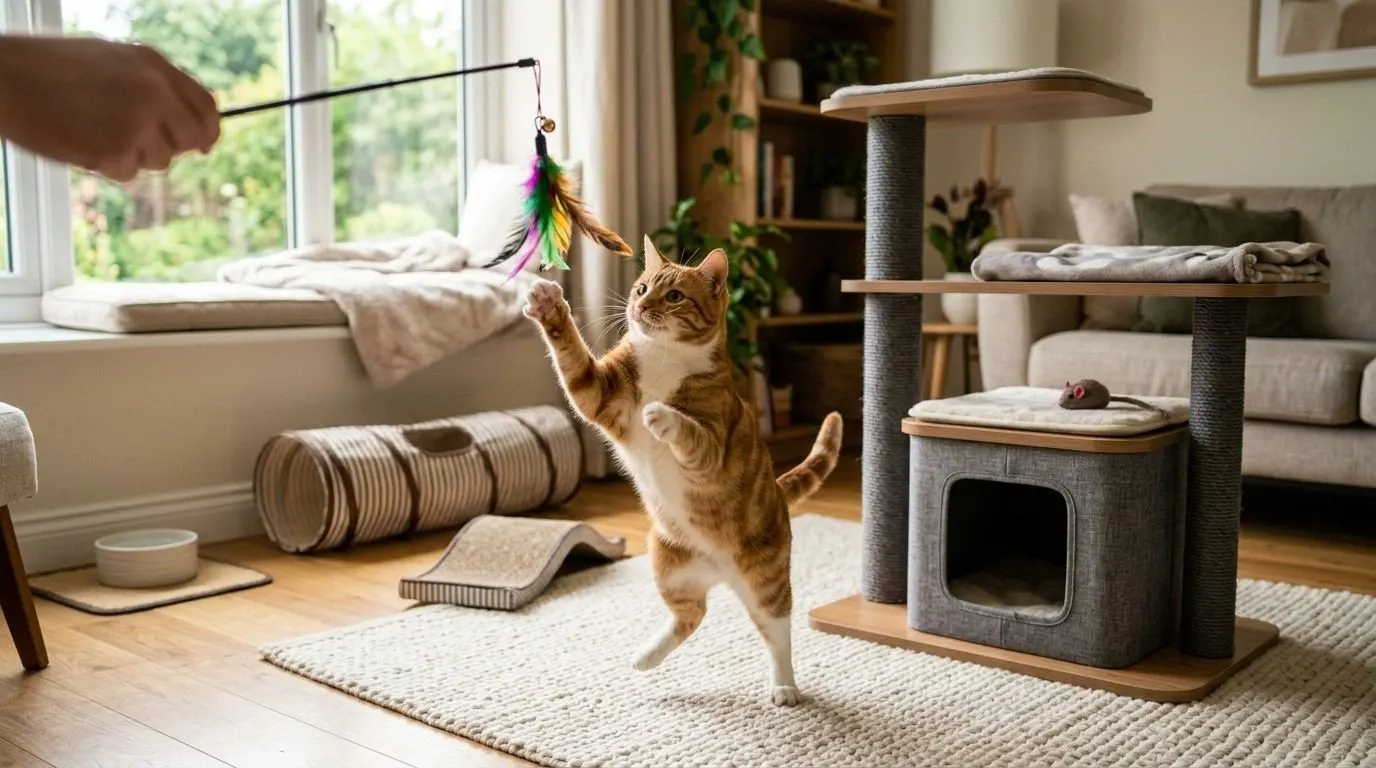
1. Use Interactive Cat Enrichment Through Play
Interactive play can be the simplest enrichment activity for cats.

Wand toys, feather toys, toy mice, and other prey-like toys can promote stalking, chasing, pouncing, and catching.
Rather than waving a toy in front of your cat’s nose, drag it on the floor or onto furniture. Allow your cat to observe and pursue, and sometimes even catch, the toy. This makes the play more interesting because the cat is involved rather than just sitting and watching a toy go past.
Tips for interactive play
- Use toys – you should never use your hands or feet.
- Move toys in different directions.
- Let your cat catch the toy every now and then.
- Keep sessions short enough to maintain interest.
- Try different toy types.
- Swap the toys so that not all toys are available all the time.
FelineVMA’s suggestions for environmental enrichment explicitly include opportunities for toy play and predation, stating that interactive toys mimic prey. This kind of enrichment can also be really beneficial for indoor cats.
2. Add Scratching Posts and Scratching Surfaces
Getting Claws: Some scratching is good for cats, so make sure your enrichment is providing your cat with the space to do this.
Offer some rough scratching posts in areas your kitty already sits and relaxes in.
Some cats prefer:
- Vertical scratching posts
- Horizontal scratchers
- Cardboard scratchers
- Sisal surfaces
- Rough fabric surfaces
Any scratching post that moves whenever it is touched will soon lose its popularity. Position scratching choices close to where your cat sleeps, relaxes, or prefers to scratch. Providing an alternative outlet for scratching is a vital part of your cat care strategy, because you don’t want to suppress all scratching. Guidance on feline behavior describes scratching as normal behavior and provides advice on suitable scratching materials and scratching posts.
3. Create Vertical Cat Enrichment
A lot of cats love the ability to stretch their body, get high up, and see the world from a high vantage point.

Vertical cat enrichment can include:
- Cat trees
- Window perches
- Cat shelves
- Secure furniture
- Elevated resting areas
Vertical space allows you to add a bit of interest to your house without the need for more floor space. Having a perch up high may provide a vantage point to watch people, other pets, or the goings-on of the world around her. Vertical choices can also be helpful in giving different cats in the household extra options for where to relax and watch the world go by. Vertical space and safe territory are an integral element of fulfilling an indoor cat’s environment requirements, as highlighted by the FelineVMA.
4. Give Your Cat Safe Hiding Places
Hiding is another great way you can enrich your cat.
A hiding place is:
- A cardboard box
- A covered cat bed
- A cat tunnel
- A carrier left open
A covered section of a cat tree. A hideaway provides your cat with a spot to escape to when they need some peace and quiet. Existing advice on FelineVMA suggests that cats should have access to safe places in which they can retreat and be protected. Don’t shove a hiding cat out because you want to play with her. Where good cat enrichment should be directed at giving your cat choices and not taking away her control over what is happening.
5. Try Food-Based Cat Enrichment
Instead of always taking the same predictable path from bowl to mouth, you can turn mealtimes into cat enrichment! Food puzzles, slow feeders, treat-dispensing toys, and easy-to-supervise food games can be used to tempt the cat to work for a portion of his food.

Hide small amounts of suitable treats or food in safe places where your cat can then discover. Food enrichment can promote foraging activity as well as provide a meal to challenge the brain. The ASPCA offers a variety of DIY food-enrichment tips, such as simple food puzzles using common household items. The ASPCA also suggests closely monitoring DIY enrichment and removing the items if the cat tries to eat them. If you are attempting a DIY cat enrichment approach, never take chances with your safety.
6. Create Window Enrichment
A safe viewing area can be a great source of visual stimulation for hours.
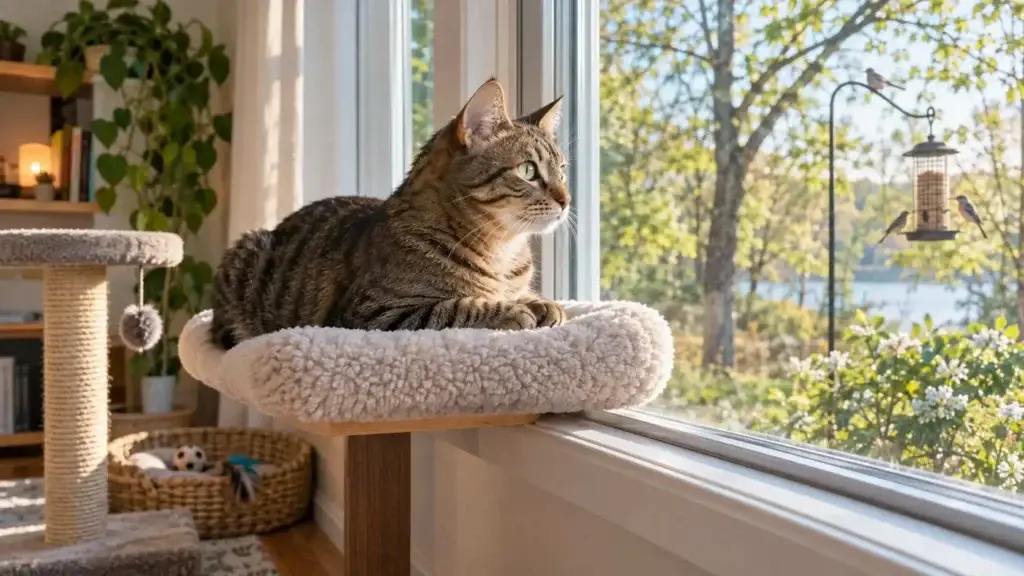
Your cat may enjoy watching:
- Birds
- Squirrels
- People
- Cars
- Leaves moving in the wind
- Rain
- Outdoor activity
People also call this a form of bird TV.
Provide a safe and elevated place where your cat can look out a window. For xample, they specifically suggest offering a comfortable window seat as an easy enrichment option. Just be certain that your windows and screens are fixed tight. Remember, a great view should not be an excellent cause of escape or fall risk.
7. Rotate Your Cat’s Toys
20 toys on the floor doesn’t equal more enrichment.
Instead, try rotating toys.
For example:
- Monday: Wand toy + toy mouse
- Tuesday: Puzzle feeder + ball
- Wednesday: Tunnel + feather toy
- Thursday: Cardboard box + toy mouse
- Friday: Wand toy + food puzzle
Then repeat the rotation with small changes. Toy rotation will provide your cat with options and keep the environment from becoming visually predictable. The FelineVMA guidelines suggest toys should be rotated to help maintain interest in play. Easy and free: Ensuring your cat can play, move and exercise is one of the easiest ways to provide enrichment.
8. Make a cardboard maze or tunnel for cats
Cardboard can become inexpensive cat enrichment.
You can create:
- Boxes connected together
- Simple tunnels
- Hide-and-seek spaces
- A cardboard maze
- Boxes with safe openings
- Temporary exploration areas
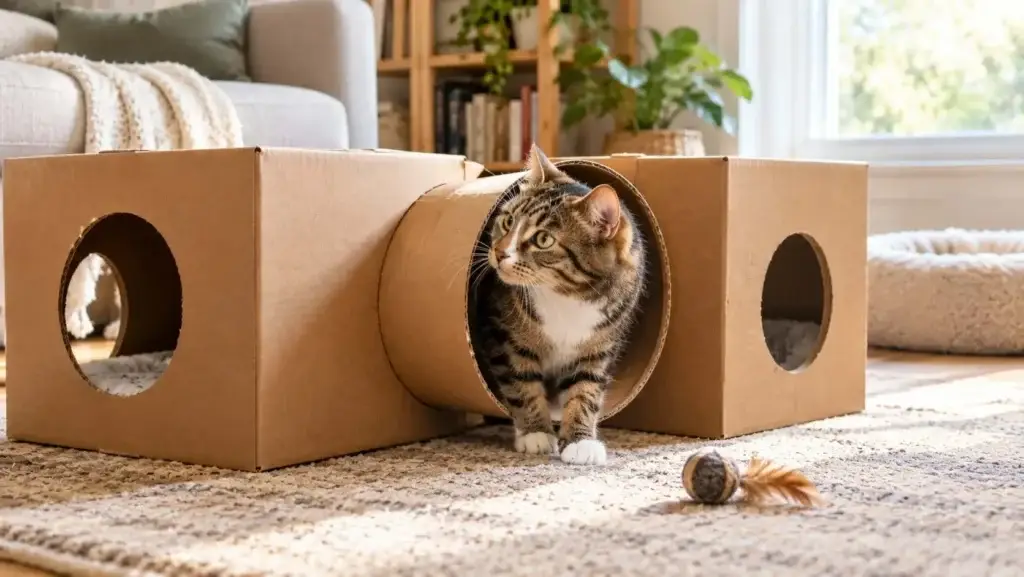
Tips from the ASPCA for DIY cardboard houses, tunnels, and maze toys, and food enrichment. Whenever you make enrichment, examine it for sharp corners, loose parts, staples, tape, string, or anything your cat could swallow. Supervise new DIY cat enrichment until you have seen how your cat uses it.
9. Allow Your Cat to Travel Safely
Studies suggest cats like to explore new surroundings.
Environment 2. You can pace environment 1 so that it becomes environment 2 by:
- A new cardboard box
- A new perch
- A paper bag without handles
- A different safe toy
- A new scratching surface
- A new resting location
Do not change everything at once. Good cat enrichment is designed to be novel without being overwhelming. Cats have a very keen sense of smell and can be sensitive to new smells or changes in their environment, which they may find stressful. FelineVMA advice advocates an environment that takes cats’ sensitivities into account with a gentle approach to avoiding potential stressors.
10. Add Simple Training to Cat Enrichment
Training is another form of cat enrichment.
Can Cats be trained with Positive Reinforcement, such as:
- Coming when called
- Touching a target
- Entering a carrier
- Sitting on a mat
- Using a scratching post
- Participating calmly in handling
Keep sessions short and reward desired behavior. Training should not become a stressful competition. When it comes to caring for cats, training can help with everyday routines, as well as the feline will learn that there are certain interactions that can lead to a good outcome. If your cat is annoyed or refuses to participate, end the session and try at a different time.
11. Provide Positive Human-Cat Interaction
Not every cat is equally affectionate.
Some cats enjoy:
- Lap time
- Petting
- Grooming
- Being talked to
- Interactive play
- Sitting beside their owner
Others prefer shorter interactions. Good cat enrichment respects individual preferences. Allow your cat to come to you. Avoid pushing your cat to contact you. Existing guidance on feline welfare stresses the importance of positive, consistent, and predictable human interactions with the cat, with consideration of individual preferences. One of the key principles of a proper style of care for cats is that communication must be such that the pet has the opportunity to take part in it.
Stimulation of an Indoor Cat: how to entertain an indoor Cat
Indoor cats can thrive and be content and stimulated-if their environment contains opportunities for natural behaviour.
Indoor cat enrichment can include:
- Daily interactive play
- Scratching posts
- Vertical climbing areas
- Safe hiding places
- Window perches
- Food puzzles
- Toy rotation
- Cardboard tunnels
- Training
- Positive human interaction
The FelineVMA lists the following opportunities and resources that cats that are restricted indoors should have available to them: play, foraging and hunting opportunities, territory with vertical space, territory with safe resting sites, and an area for toileting.
Hence, enrichment can’t just be in the form of toys. It is how you structure your house for your cat’s body, his life, his senses, and his social needs. This is something that is important to folks who love to pamper cats.
A Simple Daily Cat Enrichment Routine
You don’t need to keep your cat occupied all day.
A simple routine might look like this:
Morning
- Short interactive play session
- Breakfast
- Food puzzle for part of the meal
- Access to a comfortable window perch
Afternoon
- Toy rotation
- Cardboard box or tunnel
- Quiet resting time
Evening
- Interactive hunting-style play
- Scratching opportunity
- Positive human interaction
- Small food enrichment activity if appropriate
This style of routine can give you multiple chances to enrich your feline’s days. Flex the timing as necessary to fit your cat’s age, health, personality, and activity level.
Signs Your Cat May Need More Enrichment
It is important to note that just one behaviour alone does not constitute evidence that your cat is bored.
What you should be looking for though, are behavioral changes.
Some clues that you might need to take a second look at your cat’s surroundings are:
- Constant attention-seeking
- Destructive scratching
- Excessive nighttime activity
- Repeated attempts to access restricted areas
- Lack of interest in normal activities
- Overeating
- Persistent restlessness
- Repetitive behaviors
- Increased conflict with another household cat
There are multiple potential reasons these behaviors might be occurring, so it is not safe to just assume increasing enrichment will be effective. Any number of medical problems, stress from the environment, social strife, and other issues may influence feline behavior. Talk to a vet if your cat’s behavior changes suddenly, especially when combined with a change in appetite, litter box use, activity level, grooming, or any other health issue.
Cat Enrichment for Multi-Cat Homes
Enrichment can also be beneficial when there is more than one cat in the household. One cat will want to sleep while another will want to play. One may like to be touched while another wants the other to stay away. It doesn’t mean that you have to communalize everything. FelineVMA current recommendations support multiple key environmental resources that are separated. These include food, water, toileting, scratching, play, and resting areas.
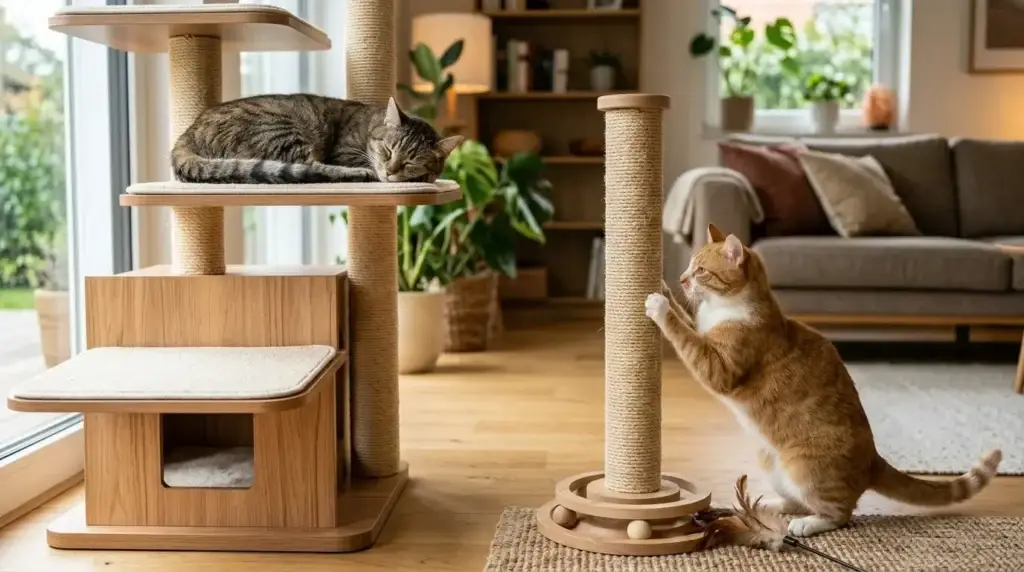
For caring for cats in a multi-cat household, consider providing:
- Multiple resting places
- Multiple scratching areas
- Separate food and water locations
- Multiple hiding places
- Multiple vertical spaces
- Individual play sessions
- Escape routes and quiet areas
This gives each cat more choices.
Is there perpetual fighting, resource blocking, hiding, or tension? Consult your veterinarian and a certified cat behaviorist.
Common Cat Enrichment Mistakes to Avoid
Cats can unintentionally sabotage enrichment, even when owners have the best intentions.
Mistake 1: Buying Too Many Toys
- Increasing toys doesn’t necessarily equal cat enrichment.
- Diversity and interaction prove to be more effective than tracking objects.
Mistake 2: Never Rotating Toys
- Most toys are attractive only for a limited amount of time.
- Try rotating toys regularly.
Mistake 3: Forcing Interaction
- Don’t make your cat play, cuddle, or come out of its hideout.
- Respecting choice is part of good caring for cats.
Mistake 4: Ignoring Scratching
- Scratching is not a problem. Designate other areas for scratching rather than assuming the behaviors is an issue.
Mistake 5: Using Unsafe DIY Materials
- DIY cat enrichment should be checked carefully.
- Steer clear of things that break into dangerous fragments, get caught up, or swallowed.
- The ASPCA recommends continuous supervision when the toy is being used, and removing it if a kitty tries to eat anything.
Mistake 6: Assuming Every Behavior Is Boredom
- Behavior issues do not necessarily constitute enrichment issues.
- Continue or abrupt changes The right time needs to be truly checked.
When should you contact a cat behaviorist?
If despite appropriate environmental alterations, behaviour issues persist, a cat behaviourist may be able to help.
Seek professional behavioural advice if your cat has:
- Persistent aggression
- Ongoing conflict with another cat
- Severe fear or avoidance
- Repeated inappropriate elimination
- Destructive behavior that does not improve
- Significant anxiety-related behavior
- Persistent compulsive or repetitive behavior
Serious problems that interfere with daily life. Disease or pain due to illness should not be a substitute for a cat behaviorist.
For instance, it is possible that an abrupt change in conduct might have a medical aspect to it. A vet can assist you in assessing any physical issues before you decide on a behavioral treatment.
If environmental modifications have not been successful, a veterinarian can also assist to identify if a referral to a cat behaviorist or another qualified animal behavior specialist is suitable. This is an important part of responsible caring for cats: behavior is interpreted in light of the physical condition and setting.
Cat Enrichment and Caring for Cats
Getting to know your cat. There’s more to good caring for cats than providing a cat with two meals a day and cleaning a litter box.
The way a cat can move, rest, play, hide, scratch, explore, and relate to their environment will be influenced by it.
So, using cat enrichment to benefit your cat needs to be an integral aspect of your daily decision-making when caring for your cat, and not a discretionary provision you give when your cat seems to have nothing to do.
A practical approach is to ask:
- Is this house suitable for a cat to fully engage in typical cat behaviors?
- Can they climb?
- Can they scratch?
- Can they hide?
- Can they play?
- Can they forage?
- Can they rest without being disturbed?
- Can they decide between people or other animals?
If the answer is “not really” to most of these questions, your home could use some more cat enrichment. The FelineVMA’s model also highlights providing safe places, partitioned resources, play and hunting/ predatory sequences, positive experiences with humans, and an understanding of a cat’s sensory profile.
Is it Good for a Bored Cat to Play with Cat Enrichment?
Yes, some suitable cat enrichment can help stimulate your indoor cat more. Experiments: Sometimes, it is preferable to combine various types instead of a single activity.
For example:
Play + Climbing + Scratching + Food enrichment + Hiding + Watching the window
Having multiple access points allows your feline to engage with its surroundings. If you don’t get any interest in one activity, don’t assume the enrichment has been a failure. Experiment with something else. One cat might enjoy food puzzles and another playing with toys. This is what makes good cat enrichment flexible.
Is Outdoor Access Necessary for Cat Enrichment?
Not necessarily. Indoor cats, on the other hand, should have plenty of enrichment, including play, climbing, scratching, foraging, hiding, and a mix of different environments.
If your cat is able to be outdoors, there are a number of different ways to allow them outside while controlling the access they have. Whether it is a secure outdoor cat enclosure or walking your cat using a harness and leash, there are ways to give your cat some outdoor experiences while staying safe. Outdoor access needs to be evaluated on a case-by-case basis for each individual cat and scenario, rather than assuming this is the sole source of enrichment.
Final Thoughts: Incorporating Cat Enrichment into Daily Routine
Cat enrichment does not need to be complicated. Just a couple minutes of interactive play, a cat tree, a good scratching post, a nice hide-out, a perch at the window, a food puzzle, or a cardboard tunnel can bring some much-needed variety into your cat’s day. The most important rule of all is to allow your cat safe choices.
Allow your cat to crawl, scratch, hide, explore, play, forage, rest, and interact as they would naturally. If you’re dedicated to caring for cats, learning about what they need will help make their homes more comfortable and delightful.
If simply providing lots of enrichment does not address the constant behavior issue, don’t go on accumulating cat toys. Try having your kitty checked by the vet, and if necessary, get advice from a professional cat behaviorist. In the end, great cat enrichment is more than just making a cat busy. It’s about creating an environment in which a cat can be naturally active, feel safe, and enrich their day-to-day life.
Cat Enrichment FAQs
What is the best enrichment for cats?
All the recommendations provide valuable choices, but nothing is perfect for each cat. With a touch of play, scratching, vertical space, hidey spots, food puzzles, watching the outside world through a window, and rotating toys, you can come up with a mix of enrichment ideas to keep your cats active indoors.
Can cardboard boxes be cat enrichment?
Yes. A cardboard box makes a wonderful safe place where your dog can get some exercise, hide away, relax, or have fun. Here are some of the other DIY ideas for paperboard provided by ASPCA. Cardboard houses, tunnels, and mazes.
Does cat enrichment stop unwanted behavior?
It can be effective when a person's behaviour is connected to unmet activity and/or environmental needs, but it is not always effective for every problem behaviour. A long-term problem might need a veterinary check, or assistance from a cat behaviourist.
Should I hire a cat behaviorist for a bored cat?
Begin by considering the cat's environment and daily routine, along with their health and opportunities for normal behavior. If there is a persistent, severe, or hard-to-understand concern, a vet and a qualified cat behaviourist can assist in making an evaluation.
Is cat enrichment only for young cats?
No. The ASPCA states that enrichment is beneficial for cats and kittens of all ages. Older cats may need enrichment that fits their mobility, health and inclination.
Can cat enrichment be free?
Absolutely. You can find some inexpensive cat enrichment ideas including: cardboard boxes, supervised exploration, rotating toys, hiding food, and playing with your new toys that will get the cat interested.


One thought on “Cat Enrichment: 11 Easy Ways to Keep Your Cat Happy & Stimulated”